My friend Susan Sabo died yesterday.

I can scarcely take it in. I knew she had cancer—she has posted freely and revealingly about it on her Facebook page since her diagnosis in October of last year. We saw the port, the chemo sessions, the hair loss, and of course all the fashion dictated by the need to cover a chilly bald scalp, by a photographer accustomed to documenting everything in selfies. And it was all delivered with Susan’s trademark wry self-mockery that she mixed with utter sincerity to disarm you. We also got to celebrate the “NED” (No Evidence of Disease) notification, eight weeks ago, which was followed, scarcely a month later, by the horrifying notice that “the ugly kid on the playground is back, and refuses to leave” and Smalldogs (her photography nickname) would be leaving the building within three to six months. And then, in only 19 more days, silence.
All I could think, when I saw her husband John’s letter on her Facebook page this morning, was “Too soon.” Just a couple of weeks ago she commented to me that she was reading a book called The Darkening Age: The Christian Destruction of the Classical World. Knowing that my BA was in theology, she was always curious about my take on stuff like this, so I put a reserve on the E-book at the library and had just started to read it a few days back, planning to discuss it with her as I went. I guess that won’t be happening, like so many other things. We had planned a reunion at Hugo’s, a favorite vegetarian hangout in Studio City, the next time she was coming to Los Angeles. We used to go there back in the 1980s when I first knew her; a few years back, when she was in the middle of a cold Michigan winter and I mentioned to her that I had met a librarian friend there for dinner, she wistfully wished we were sitting by the window on the patio, having a Very Green Casserole together.
I first met Susan (then Brooks) in 1984, when we were the only women working for Liberation Publications in Hollywood, in the building across from Graumann’s Chinese Theater on the boulevard. I was the typesetter of The Advocate, the national bi-weekly gay and lesbian newsmagazine, and she was the editor of Advocate Men. I was already sufficiently scandalized by my own daring in taking a job with a gay magazine (my parents were Fundamentalist Christians), but the hutzpah of this skinny blonde chick who was editing the stories and writing the advice column for the gay equivalent of Playboy truly amazed me.
Even though at our office (which housed the editorial and art departments—everybody else was out in Malibu at the publisher’s house) we were the only people who were both straight and female, lost in a sea of gay men (40 of them!), we became friends slowly and cautiously. Up to that point in her life Susan hadn’t been much of a “girlfriends” kind of woman—she gravitated more naturally towards friendships with men—and I was shy and kind of an introvert. The turning point came one day when she came into the office carrying a fancy short white lace dress and hung it up on her door; I asked her if she had a date that night, and she replied, No, I’m going to go get married on my lunch hour. Um, what?
She and her daughter Jenna had been living with a guy named Tony and his daughter Phoebe for a while, and they had decided that today was the day. I can’t for the life of me remember the reason behind why they would go to City Hall at lunch hour, get married, and go back to work, but I’m sure there was a good one that included some twisted logic to justify the impulsive behavior. There always was. There aren’t too many people to ask about that any more, because this was the beginning of the AIDS crisis, when all the gay men were getting it but there were, as yet, no diagnoses, no medications, no cures, and no one outside their community who seemed at all interested in finding solutions. Ronald Reagan wouldn’t even say the word, and by the time it was over we had lost 90 percent of the staff.
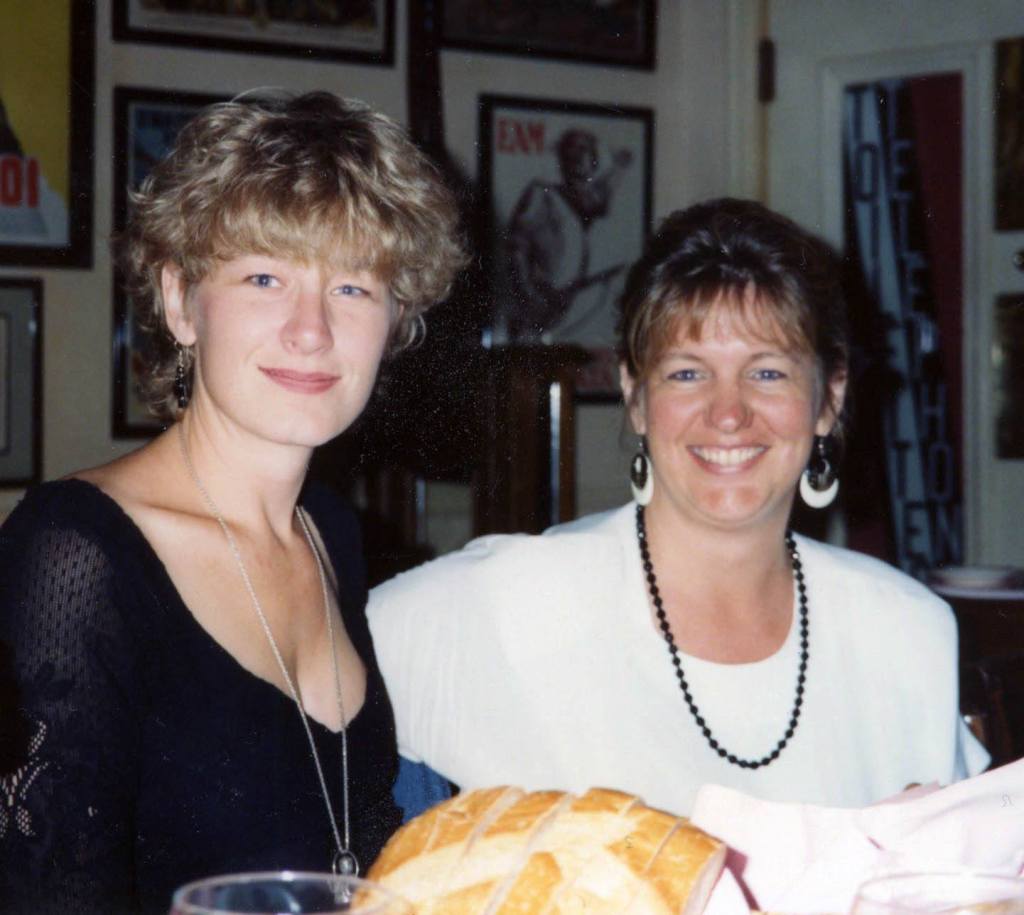
Once we got past the overture stage and became friends, Susan was unique in so many ways compared to the other women with whom I hung out. She wasn’t girlie at all, but was effortlessly cool at all times—clothes, hair, car, everything. We didn’t do much of the traditional friend stuff—we never went shopping, couldn’t afford to go out to eat too often, and as a single mom she didn’t have a lot of time left over for others when her priority was Jenna. But she would do something none of my other friends dared to do, and somehow it was okay with me: She dropped by.
In general I am horrified by the idea of people dropping in unannounced, but Susan did it in such a perfect way that I actually looked forward to it. She would stop at some fast food drive-through for an iced tea or a soda, then pull up in my driveway, knock on the door and stroll on in. We’d sit down in the living room and she would chat about random stuff for about 20 minutes while drinking the refreshment she had provided for herself, and then she’d bounce up from the couch, say “gotta go!” and she’d be off again. I still miss that whirlwind dynamic.
Although her life was chaotic at times, there was a bedrock of admirable qualities defining Susan that were slowly revealed as I got to know her better. I became a vegetarian a year or two after starting my job at The Advocate and, as new converts will do, gently nagged Susan to be one too. She ignored me until the day she saw a documentary about what happens to pigs raised for meat, and she never ate another bite of another living creature. She was loyal, somewhat hot-headed, and always stood up for what she thought was right. She was also funny, foul-mouthed, and always a fascinating person to be around.
Susan was (then and all her life) a staunch advocate for dogs, and she and Jenna decided they wanted to volunteer at the local shelter. They started out just visiting the dogs, but then Susan saw a need and decided to take care of it. They collected towels and blankets from people to donate to the shelter for the dogs, and then upped their involvement by going to the shelter each week, gathering all the soiled towels and blankets into giant plastic bags and taking them to a laundromat, where Susan paid out of her own pocket to wash and dry them, then delivered them back, neatly folded, to the shelter for another week’s use. They did this for many months, maybe for years. And everywhere she went in her life after that, there was nearly always involvement with a local shelter, usually in the later years by taking charming and quirky photos of the dogs so as to get them adopted more quickly.

Although most people know her as a photographer, Susan was also a gifted writer and, despite her preference for reading nonfiction, wrote a couple of novels. She also published a ‘zine called Real Girls for a time (I contributed a couple of stories), and later, based on the ideas from that, she wrote a book called Any Girl Can Rule the World, “a proactive, pro-girl guide to making a real difference in the world by, among other things, becoming a political activist, starting a ‘zine, investing in the stock market, or producing a cable TV show.” She was determined to model the behavior she wanted her daughter to learn.
Susan and I had a falling out in the late ’90s that I will freely admit was completely my fault. She was hurt and bewildered by my attitude, but I was firmly convinced of my position and wouldn’t budge, and we didn’t speak again for many years. I eventually experienced something of an epiphany in an interaction with another friend and realized just how badly I had misjudged and handled the situation with Susan; I decided to approach her online to say sorry for how I had behaved. She was understandably cautious of me at first, not sure she wanted to renew the connection, but the awkward phase passed once she was finally able to believe I was sincere, and I had the pleasure of being her online friend for the past 11 years.
I discovered that she was still exactly the same, only more so, and that I liked this person as much or more than I had liked her when we were in our 30s. I’m sad we lost all that time due to my wrong-headedness, but so grateful we reconnected. I miss her already.


 MEdoubleLL
Leave a reply to Corinna Cancel reply