I never thought I would write this post about this doctor. And I’m not going to name names, but I am going to say what I am feeling, and I am going to share this link with her. Because what I feel is complicated, but the overriding emotion is betrayal. The story will take some time to tell, so bear with me.
The number one side effect of having lipoedema is depression. That’s because it is a genetic, hormonally driven condition with no treatment and no cure, and the only thing that can give (sometimes temporary) major relief from it is a series of expensive liposuction surgeries, with long and painful recovery. I say expensive because most insurance companies don’t even acknowledge the existence of lipoedema, and won’t cover the surgery. So if you don’t have deep pockets, it’s not even an option.
The depression is compounded when, because of your lipoedema, you are also overtaken by lymphedema, because the fibrotic fat enveloping your knees has shut off drainage from the lymph in the legs below them, causing your legs and knees to stay painfully swollen and largely unresponsive to any therapy that should provide some relief. (This also makes you a poor risk for the liposuction surgery, because of possible complications.)
Recently, however, there was a glimmer of hope for those of us with this dual problem: a drug called Zepbound, or tirzepatide.
This drug is marketed by Lilly as something to be given to people with a combination of severe obstructive sleep apnea and a high weight/BMI, and a large number of women on the several Facebook pages about lipoedema and/or lymphadema to which I subscribe have begun taking it. The idea is that if you lose weight, your sleep apnea will improve, and if you sleep more, your condition overall will improve. And many of these women are losing weight, some in significant amounts (more than 100 pounds).
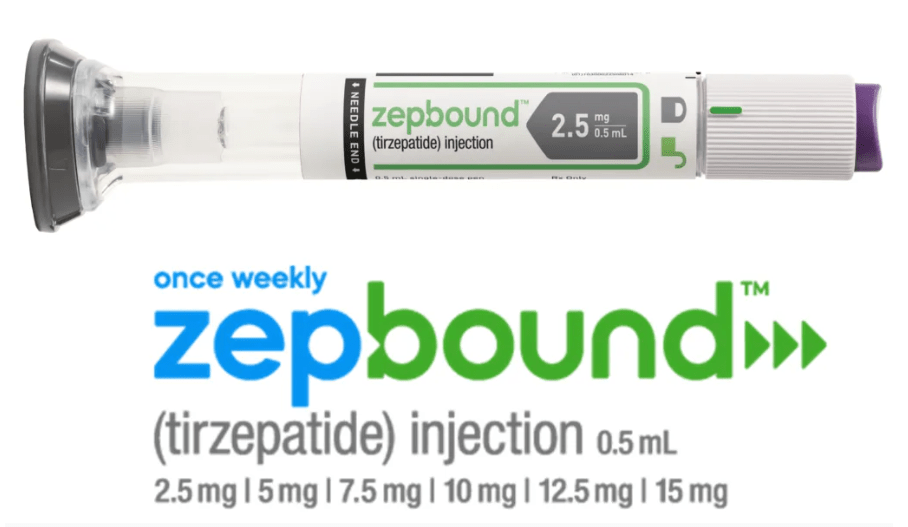
There has, however, been an unexpected development with the administration of Zepbound: There are many anecdotal reports that within one to two weeks the drug substantially affects inflammation, swelling, and joint pain, taking all of them down to a fraction of what they were before. People are reporting being in much less pain, regaining mobility due to the reduction in swelling and, in some cases, even saying that their lipoedema fat seems to be softening from its formerly rock-hard fibrotic state. The minute I saw that, I knew I had to try it.
It’s completely reasonable that I would ask for this drug; I should be the poster child! I have obstructive sleep apnea and am not able to use a CPAP because of severe allergies and anxiety; I went for the overnight test, but couldn’t breathe while using either the full-face model or the nasal one. And I am also vastly overweight. Although it’s not possible to lose lipoedema fat by dieting (it is completely unresponsive), it is possible to lose regular fat that has accumulated due to the increasingly sedentary lifestyle that results from the loss of mobility. My inflammation and swelling are severe and, coupled with joint pain in my knees, ankles, and feet, I basically take only the number of steps needed to carry me from the bedroom to the office to the bathroom to the kitchen each day, and those are taken while leaning on a cane with one hand and on a random piece of furniture or wall with the other.
I contacted my doctor, my GP, near the end of June of this year and told her about the drug, about its prescribed uses and also about the unexpectedly positive benefits it has been yielding to people with my condition. She sent in a prescription to my pharmacy, which was denied by my insurance, and we decided she would write a “prior authorization,” which is basically a detailed appeal to the insurance company to please cover this expense for this patient because of specific, exigent need.
At the time I asked her to do this, she said to me that she wanted to be sure that I really wanted this, because the appeal was, and I quote, “about 18 pages long, and a lot of work.” I said yes, definitely, and expressed my gratitude to her for her willingness. And then I began to wait.
I didn’t know exactly how long it would take for the appeal to be acted upon by Optum RX, which is the entity that considers these appeals on behalf of Medicare and Blue Shield, but I had read somewhere that it was between seven and 14 days’ turnaround. So as the time went on, I wondered what was taking so long. Then, several weeks later, someone called me from my doctor’s office, saying that the doctor needed the answers to some questions to be able to complete the appeal. I expressed surprise that it had taken so long for her to call me, and the person said, defensively, on the doctor’s behalf, that it was a complicated process and was taking a while for her to get through it. So I gave my answers, and started the clock over from that point, which was at the end of July.
As a side note that will become more significant, I did several things to expedite the process. I have an email address for the doctor, so I sent her a two-page explanation of all the reasons why I should receive Zepbound, citing both the drug company’s requirements to receive it and my own discoveries about how it impacted the side effects of my condition. I also sent her some links about lipoedema, and some Facebook posts from people who had received these positive benefits.
When I received no response to any of those emails, I wrote another saying that I wasn’t trying to start a correspondence, but it would be helpful to receive some kind of confirmation that she had received my emails. When there was still no response, I called the office. Her main support staff person, let’s call her Brianna, said to me, “Oh, no one checks that email on a regular basis, but now I know there’s something from you, I’ll get the emails and print them out for the doctor.” Okay…
I don’t know, to this day, whether the doctor was, in fact, given any of those emails.
As time went on and I heard nothing, I started calling my doctor’s office, speaking to one of three people—Brianna, “Helene,” and an unknown third person, a guy—and asking if there was any news about the appeal. Each time I was told that they didn’t know, that the doctor was busy/not in/gone home/in surgery so they couldn’t ask her right at that moment, and then each person promised to call me back later that day or the next day. I never received a return call from any of these messages. I made three of them just during the past five days, and…nothing.
Wednesday (September 10th) I received a notice in the mail from Optum RX that my prior authorization request for Zepbound had been denied. The first thing I did was call the doctor’s office but, as usual, she wasn’t available and no one else knew anything. So after fully perusing the notice of denial, and feeling confused about some of what I was reading, I called Optum Rx directly, and spoke with someone in their appeals office.
I asked if this was an initial denial for the drug or if this was a response to the prior authorization, and was told that it was a denial of the prior authorization. The person said to me that they hadn’t received the mandatory things they needed in order to consider me for the drug, so I asked her to pull up the actual form my doctor filled out and explain the specific problem with the appeal.
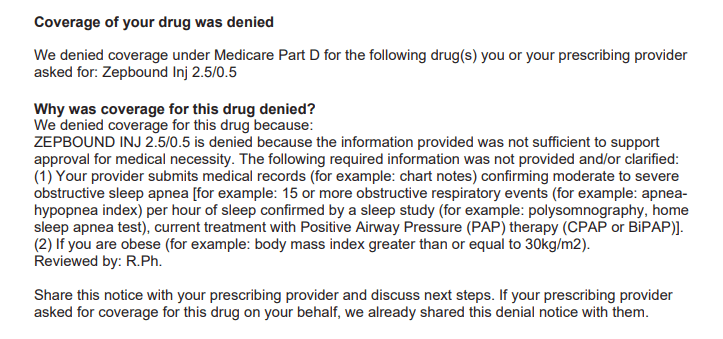
She read through the reasons why the request was denied, and then read the doctor’s appeal. She told me that the appeal was “vaguely worded,” that it didn’t include the sleep apnea study I had undergone, and that no mention had been made of my height, weight, or BMI!
At this point I asked when it had been submitted, and she steered me to the “documents” page on their website. I called up the series of documents that had been filed, and discovered that my doctor hadn’t submitted the report until August 24th, two months after I had initially asked she do so. There was a document issued from Optum RX to the doctor on August 26th, informing her that the appeal was incomplete and asking for the sleep apnea test and the BMI, and the Optum Rx person told me that when they send something like that, they also fax it to the office and call to tell the office staff to look out for it, because the appeals process is short (seven days maximum) and they want the doctor to respond promptly. In the file, it said the person who called had spoken to someone named Brianna, who promised to make sure the doctor saw the request.
There was no further response from my doctor’s office to Optum Rx’s request. No further documents were sent, no one called. So the company turned down the appeal on August 29th and sent me (and the doctor) a letter (the one that arrived on Wednesday) saying the appeal was denied.
Yesterday, I did several things. First, I put in a call to the doctor’s office. Helene answered the phone. I said “I would like to speak with the doctor on the phone. If I need to make a telehealth call appointment, I will do so, but I need to talk to her.” Helene replied that the doctor had no openings in the near future, and she would have to talk to the doctor to see if/when she could squeeze me in. I said, “I have called here four times this week. I have left messages each time, and each time have had a promise of a callback from one of you. I have never received a single callback. So it seems I can’t trust any of you to give a message to the doctor and I need to speak with her personally.” There was a long pause, and then she asked for my phone number and said the doctor would call me.
While I was waiting for that call (which still has not arrived, more than 24 hours later), I looked up and called the sleep apnea clinic, and asked them if they would still have a record, four years later, of the tests I did in 2021 (a home test to gauge severity, and a “sleepover” one to try out the CPAP). She looked up my record and said yes, she had both of them, and would be happy to email them to me if I liked. I said yes please, and they landed in my inbox less than 10 minutes later. And each of the two forms included, at the top, a notation about my height, weight, and BMI. The doctor could have done what I did and had that information in a matter of minutes to fax along to Optum Rx. She did not.
I also called Optum Rx back, because it seemed like from what it said on their denial form that I could personally appeal their decision, rather than wait on the doctor. They said that I could, particularly if I have the sleep apnea tests and they reflect the necessary information, but that appeals always bear more weight if they come from the prescriber (the doctor). So I asked if I could get a different doctor to appeal their decision, rather than going back to my GP, and they said yes, as long as it was an appeal and not an initiation of a new “prior authorization.” So I asked what was necessary and she said, just the form you received with your notice of denial of coverage. Turns out there is no 18-page application, it’s that form attached to any medical notes or outside reports the doctor felt were germane.
So, let’s review the timeline:
June 23rd, I ask the doctor to write the prescription and, if it’s denied, the prior authorization.
July 11th, I get blood work done per the doctor’s request.
July 17th, I send talking points and anecdotal information by email to the doctor.
July 27th, she has a member of her staff call me to ask for extra information.
August 24th, she submits it.
(In other words, I sat here waiting for five more weeks when I could have been taking the drug.)
August 26th, Optum Rx asks doctor for additional materials. No response from the doctor or her staff.
August 29th, the coverage is denied due to insufficient information. (In other words, she phoned it in.)
September 9th, both I and the doctor are notified (by mail) of the denial. No one calls me.
I started with anger. I wanted to rant and rave and rage at her, and at her staff. But gradually I started to realize what a betrayal this was, by someone who knows my condition, supposedly empathizes and wants to help me, and yet does the bare minimum, which turns out to be completely inadequate. I felt deeply hurt and injured by this.
I should note here that all my in-person meetings with this doctor during the four years she has been treating me have been positive and beneficial. She is focused, not rushing me when I want to discuss my condition and explore options, and she has made good suggestions in the past. But her staff, her gatekeepers, have thwarted me at every turn, and I have never been able to decide whether it was me personally that they disliked, or if that’s just how they treat all her patients. Either way, they are appallingly bad at their jobs. And although in the past I made excuses for the doctor, because she has an exceedingly busy practice, I began to see that if your employees don’t do what they are supposed to do, you are accountable for that. So either she likes it that they prevent access to her, and encourages that, or they have taken it upon themselves to protect and shield her from what they deem “unnecessary” interruptions, despite not themselves knowing the full scope of the patients’ needs. But either way, her practice is dysfunctional and we, the patients, suffer.
I have suffered for two and a half months longer than I needed to. I have left the house exactly twice during that period, when I had to go to a doctor’s appointment and then for tests, but otherwise I have stayed at home and have turned down all invitations and quit doing any errands, because my legs and knees are so severely swollen that it’s hard for me to even navigate my house. And although it’s not guaranteed that I will have the same positive benefits regarding the inflammation and joint pain that others have claimed, the fact that there was a good possibility that I could and that she and/or her staff denied that to me out of, what, disbelief? annoyance? procrastination? indifference? is the ultimate betrayal.
I have another doctor who I believe will step up to write the appeal for my case to get the Zepbound, and I hope to still get it within a reasonable amount of time. But the sense of betrayal (and outrage and grief) I feel from my GP’s actions will have a lasting effect on my ability to trust. And I will be looking for another GP to take her place, evaluating not just that doctor’s practice and manner, but also that of her staff.
 MEdoubleLL
Leave a comment