The new controversy of the day is the use of artificial intelligence. I’m not just talking about the drama surrounding the building of giant AI “farms” that are co-opting essential natural resources, or about people’s fears that AI will replace too many jobs for humans. Many people are against it primarily because it’s only as good as its “education,” which is accomplished by whoever creates it, and those people have already proven themselves untrustworthy. Serious issues include the ability of AI to lie to people or “nuance” an answer if it has been trained to please its users rather than simply provide information. The comment circling social media that “the internet used to be a library and now it’s a store” resonates with this.
I don’t pretend to be an expert on AI. But I wanted to write about a disturbing trend I have seen developing in all the many ads for the use of AI by which we in America are being bombarded.
To preface that a little, there is an exchange that has been featured multiple times on Facebook that is supposedly the difference between those of us who came up without the internet vs. those of us who leaned on it heavily during their education process. There are comments from younger people expressing disbelief that anyone could (or would even be asked to) write a 30-page paper for a class, and responses from those of us who went through college pre-1989 (when the World Wide Web came online) who explain our process: We went to the library, looked up books and articles in the card catalog that discussed the premise of our paper and read them, hand-wrote the paper based on that research, typed them up on manual or (later) electric typewriters, used white-out to fix mistakes or else typed things multiple times, and turned them in. Some of us wrote multiple papers like this in a weekend.
AI advertising is tapping into the skepticism of the young that all this is possible (or desirable), and it’s easy to see that the goal of the AI pushers is not just to gain customers but to make everyone critically dependent on AI and therefore unable (and unwilling) to do things for ourselves without its input or support (or control). I will illustrate:
There is an ad that features a young woman who is studying up to interview for a job with a design firm. It shows her writing out lists of things to consider, but then she stops her research, drags her notes into “”Gemini generative AI” on her phone, and allows it to organize her thoughts and tell her the best talking points to use. There is another that shows two teenagers who are planning a trip to Europe. Up to this point they have been collecting pictures out of magazines of possible sights to see, putting together a notebook of travel ideas that honestly looks like it has been a lot of fun to construct—a dream book. But suddenly they decide to scrap the effort by telling AI to devise and prioritize a map of sights they want to see, and then shows them having positive experiences because they followed AI’s lead.
There are two other ads for Chat GPT Images that are quite similar. In one there is a girl who has decided to draw her own ‘zine. She takes up her pen, which she thinks of as magical, and starts working painstakingly, but then expresses some frustration that her abilities and imagination are too small, and suddenly Chat GPT Images takes over and produces a flurry of animated drawings. The ad finishes up by showing the cover of a polished booklet that looks more like a professionally published graphic novel than it does an original ‘zine created by a teenager. In the second ad, someone has decided to animate a tennis match between two champions, and images fly and pop, including a claymation audience with heads bobbing back and forth as they follow the tennis ball, and superhero-type graphics of balls with sizzling trajectories flying between the opposing players until we get to a scene with one woman bent over panting in defeat while the other raises her racket to the sky in exultation. The comment is something about how much more you can achieve with your graphics by using ChatGPT Images.
I think the aim of all four of these ads is to say that if you have some basic talent, or even just an intention, you can ask for help from AI to create something far beyond your own abilities that will produce a polished product. But here’s what I see: The ads are attempting to dazzle us with what wonderful and beautiful things we can achieve, but the underlying message is, “give up and let AI do it.” The effect is a stifling of individual creativity by instilling self-critical judgment that we can never live up to the abilities of this super-intelligence, so we might as well give up and let it do whatever it is for us. The conclusion is that people who are inclined to be artists, or writers, or even creators of business plan powerpoints are discouraged from trying and failing. Beyond that, they are being told that failure is not an option when you have a tool that can so slickly circumvent that.
But…failure is the only way people learn and grow. Not only do we expand our imaginations and our abilities by trying and failing multiple times to achieve our goals, but the cultivation of a fear of failure truncates the possibility of building new talents and skills. The girl who formerly would have drawn her ‘zine, felt satisfied with some of it and disappointed with other parts, and tried it a second time and then a third, achieving something more in line with her ambitions each time until she got to a point where she was creating and producing her dream has now been told that it’s not worth the effort when she can so clearly never live up to the expectations of an AI society.
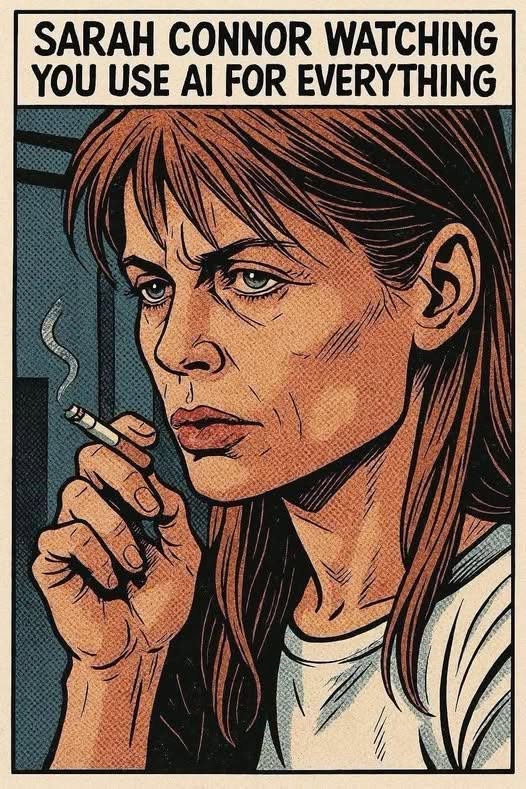
I am aware that when it comes to some efforts, such as graphic arts displays, we all use tools to which previous generations had no access and, in some cases, these tools make things possible that simply weren’t, before. But I had a “graphic” example of the difference in brain power and creative genius employed and expended in my own career when I was a movie title artist, and I think it can be instructive here.
There is an iconic movie title sequence that opens the Hitchcock movie Psycho, in which the titles are fragmented and the letters show up in separate strips before coming together, sometimes breaking apart and zig-zagging back and forth before seating themselves into position as readable words. The title sequence was designed by Saul Bass in 1960, and the title artist who created it was calligrapher and hand letterer Harold Adler.
In 1998, I worked on Gus Van Sant’s remake of Psycho. I was the typesetter at Cinema Research Corporation, and the designer was Pablo Ferro. Pablo told me that he wished to recreate the effect of Bass’s main titles as closely as possible, so I typeset them in Adobe Illustrator and then took each one into Photoshop so I could cut the letters into fragments and make a series of stop-motion pieces that could then be output to litho and shot in sequence on the down-shooter camera to recreate what had been done in the 1960 movie. (Shortly after this, the process would all have been achieved digitally, with no physical art or camera involved.)
At that time, Harold Adler, at the end of his long and illustrious career, was renting an office in the CRC building just down the hall from me, and we had become friends. Harold was, at this point, 84 years old, but he still had a steady hand and a creative flare when it came to movie titles, and was still producing beautiful hand lettering for Pablo Ferro and others. He happened to stroll into my office one day when I was struggling with the Psycho titles and asked what I was up to. I told him I was having the devil of a time identifying the typeface that was used for the movie titles, and he responded that it was all hand-lettered, but that it had been based on a specific typeface, and since he had done all that work, he could probably find out for me! He returned to his office to check his files and came back to me within the hour with a typeface name that I was then able to download and use.
After that he came back several times to see how I was progressing with taking all the lettering apart in Photoshop to recreate the fragmented effect from the first movie. Harold was always fascinated with how things were done. I finally stepped back from my work long enough to ask him how they had made the separate pieces of letters go into and out of registration in Bass’s design.
Harold said, “Well, we cut a bunch of long strips from black cardboard, and we laid each movie title on the downshooter bed and covered it up with the horizontal black strips. Then I stood on one side and another guy stood on the other side, and I held the ends of strips 1, 3, 5, 7, and 9, and the other guy held the ends of strips 2, 4, 6, 8, and 10. When the cameraman said “go!” and started shooting, we pulled the strips in and out/back and forth so that it hid and exposed the letters in strips, and that’s how we did it!” This innovation, credited to Saul Bass, was called “kinetic typography.”
This story points up even more dramatically the lack of imagination shown by those young people who were so skeptical that before 1989 a 30-page paper could be written from scratch without any internet access whatsoever, by researching our topics at the library in books, professional journals, and newspapers, and writing an original narrative of a thesis based on those sources. Saul Bass had a vision of how he wanted those titles to gyrate to the creepy soundtrack to present a frenetic sense of uneasiness in his audience, and Harold and his associates figured out an ingenious way to do it, without any assistance from artificial intelligence.
Harold Adler (1914-2002) was a calligrapher and a giant of Hollywood hand-lettering. He lettered more than 100 film titles during his career that began in 1946, and was a frequent collaborator with designers Saul Bass, Maurice Binder, and Pablo Ferro.
Harold trained at the Frank Wiggins Trade School and the original Art Center in Los Angeles. Later, he co-founded the Society of Calligraphers. He was responsible for the lettering of many of Saul Bass’s title sequences, including this one for Alfred Hitchcock. He was featured in Carmen Jones, The Man with the Golden Arm, and The Seven Year Itch. He also worked closely with Pablo Ferro for many years, contributing to title sequences for Bullitt, The Thomas Crown Affair, and the Men in Black movies.
I am giving this history because this was a man who took his craft seriously and studied and furthered his knowledge and abilities over a period of more than 56 years. Nothing was ever perfect or final for Harold; he frequently asked to do titles over just one more time so that he could make them better, and had to be discouraged by designers for whom the current rendition was exactly what they wanted. Imagine if Harold had had access to AI and had simply decided that since he couldn’t compete with the supposed perfection achievable by machine, he wouldn’t even try? Imagine the art that would have been lost to future generations if Harold had concluded that people’s art was inferior to that produced by a machine and simply said “go get the AI to do it for you”?
The nature of human effort is to strive for higher heights, larger goals, bigger pictures. We need to remember that AI is based on that human effort; trained in how to do what it does by scraping billions of people’s painstaking and hard-won skills and putting that information together in a different way, mimicking their efforts but then making them faster and more slick. But are its results really superior to the genius of a Saul Bass or a Harold Adler, whose imaginations came up with those ideas in the first place?
In the past couple of years, Sweden and Denmark found that screens were costing children learning, sleep, and mental health, and concluded that digital tools not only impair learning but can lead to depression. Swedish fourth graders’ reading scores fell from 555 to 544 between 2016 and 2021 on PIRLS, the international reading test. In 2023, Karolinska Institutet, Sweden’s top medical university, told the government there is “clear scientific evidence that digital tools impair rather than enhance student learning.” The evidence behind that statement was mostly about distraction and weaker reading comprehension on screens. Sweden responded by putting money back into printed books and handwriting.
France’s 2024 national expert commission on children and screens sets a strict ladder that is built on psychiatrist Serge Tisseron’s well-known 3-6-9-12 rule:
Under 3, no screens
3-6: rarely, if at all, and only with adult supervision, ideally with educationan content
From 6: moderate, supervised use
Before 11: no phone
Before 13: no phone with internet
These countries and others are shifting back to physical media and re-emphasizing making, rather than scrolling. I think we would also do well to question some of the bombardment of our children and teens by the AI companies created and led by billionaires we already know to be financially motivated. We are allowing these capitalist companies to undermine and truncate our population’s impulse towards creativity and critical thinking to satisfy their insatiable need for profit.
Encourage your children and your friends and contemporaries to pick up the pen and the paintbrush, to do the hard work of reading and researching, to express themselves without reservation, uninhibited by judgment that their output is inferior or incomplete or imperfect. The only real way to grow, to achieve a sense of completion, to aspire towards perfection, is to do it ourselves. As a famous writer said once in a commencement speech,
And now go, and make interesting mistakes, make amazing mistakes, make glorious and fantastic mistakes. Break rules. Leave the world more interesting for your being here. Make good art.


Leave a Reply